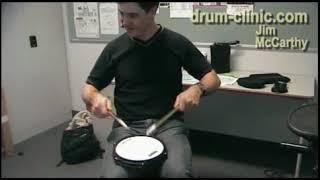
Video excerpts of live drum lessons 6 — more drum rudiments
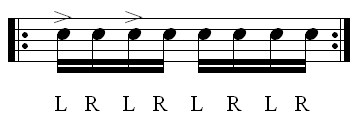
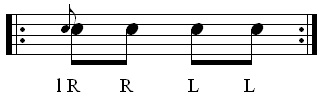
The single stroke four and the four stroke ruff — two rudiments that look almost identical on paper and are quite different to play. Worked through with a beginner student.
Drumming · Technique · Rudiments · Gear · Lessons & Learning
Every post on drum-clinic.com, newest first.
The single stroke four and the four stroke ruff — two rudiments that look almost identical on paper and are quite different to play. Worked through with a beginner student.
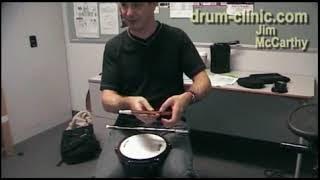
A basic exercise for developing rebound through the wrist and fingers, and some ways to improve the fulcrum so that the fingers work more in conjunction with the wrist.
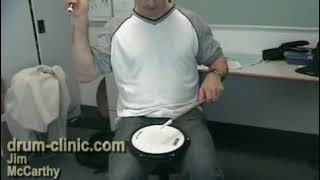
Two clips with two different students. The first works through the paradiddlediddle and the diddle-egg five; the second takes another student through the diddle-egg five and the diddle-egg seven.

Third in the live lesson series. An exercise for building strength and control in the fulcrum, and for developing finger technique in general.
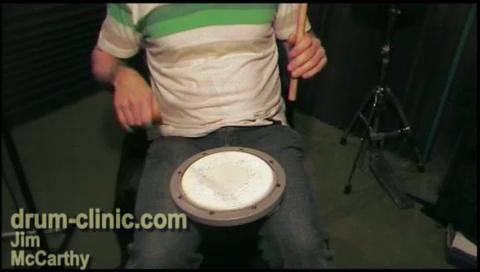
Second in the live lesson series. Fundamental technique with a real beginner — grip, and singles and doubles with good rebound, via the “singles to doubles” exercise my students all know.
A long exchange with a self-taught reader. How to actually get a rudiment faster, why relaxed hands only work once they are programmed, how to develop passive finger control by isolating the elbow, and how to combine wrist and elbow without wrecking your joints.
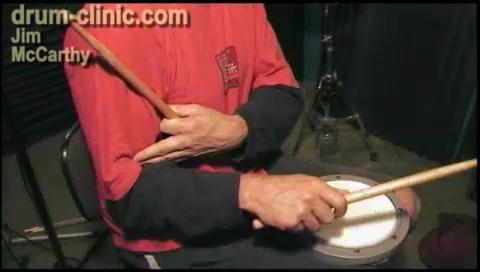
Clips from a real lesson with a beginner student — hand position and grip at the kit, working through semiquaver rests from the Begin Drumming book, and a look at paradiddle exercises and technique.
I joined a drum forum to answer questions from drummers dealing with blisters, cramps and injuries. Two hours later every post was deleted and my membership was gone. A word about why this site stays free.
A customer asks whether the secret to good doubles is accenting the second stroke. It isn’t — and chasing that will teach you to bend the wrist and waste the rebound. The fix is to stop overplaying the first note instead.
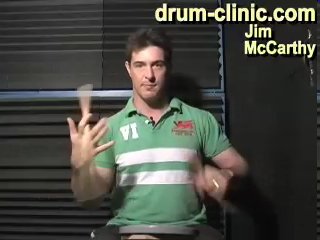
The two are not the same thing, and most drummers have the names backwards. Why a spin is a parlour trick you cannot play through, why a twirl takes almost no transition time at all, and how the twirling grip is nearly a matched grip already.
Twenty years of teaching without ever finding a book that covered the thing that mattered most. Changing grip in my honours year, a shelf of physiology books that happened to be in the house, and discovering that much of what I had been taught made no biological sense.
From the NARD 13 to the NARD 26 to the PAS 40 — and that last one is a quarter of a century old. Are the standard rudiments still relevant, and do they even hold up under a little scrutiny? Announcing the full article.
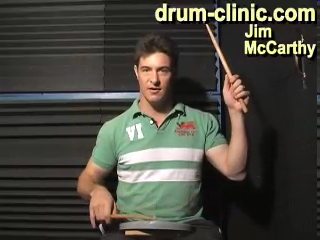
Two-part video plus three excerpts from the book. How to work out the stroke type of every note, what has to be compromised once you play fast, and the dropped-stick experiment that shows the paradiddle is already almost the rhythm the stick wants to play.
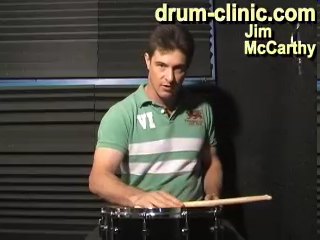
One snare drum, a great many sounds. Where to strike and why it matters, why the far edge and between the lugs, what a rimshot actually is, and how rimclick and stick-on-stick differ — including the trick for getting a buzz out of stick-on-stick.
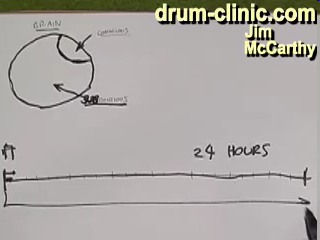
Two magic numbers. Why 20 minutes is the threshold at which your subconscious starts working on the problem — and keeps going for 24 hours — and why five sessions a week gets you four times as far as three, for less than half the total practice.
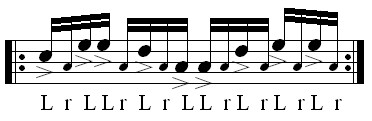
Week ten. A tambourine and shaker exercise for unmatched grip coordination, turning wingnuts the hard way, the clearest explanation I can give of why your doubles and triples fade, and a groove that reverses the usual roles of the hands.
Those running 16th disco grooves are nearly always played as single strokes led with the right hand. Try left-hand-led paradiddles instead — more time for the backbeat, a natural pulse on the hat, and a shuffly funk feel if you keep the right hand off the hat altogether.
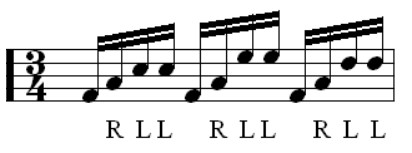
Week nine. Building the fulcrum on a vertical bass drum, painting the fence Karate Kid style, swapping your snare and floor tom so the weak hand fights a softer surface, and a cheat’s double kick groove that works the weak hand twice as hard.
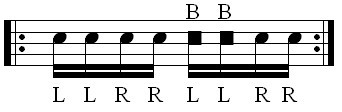
Week eight. Swapping your grips over entirely, brushing your hair with the wrong hand, using stick pitch in reverse to force the weak hand to work, a three-way weak hand pattern, and a backsticking exercise following on from April’s article.
Week seven. Why you cannot power a traditional grip with the index finger no matter who tells you otherwise, learning a piano scale, deliberately mismatching your sticks, why drum fills nearly always descend, and an exercise using all four stroke types.
Two-part video plus the written detail. Why most drummers are actually butting rather than backsticking, how to make the rotation read as a true 180 degrees, where the fulcrum has to move to, and the whole movement described step by step.
Week six. Independent rolls using the Burton grip with two sticks in one hand, cutting shapes out with scissors, forcing the weak hand to work by playing on a cushion, two drum kit ostinatos, and a drag exercise that tests the wrist-to-fingers transition.
Week five. Saving your index finger when backsticking, bouncing a tennis ball for stick feedback, recording yourself to hear your own unevenness, and two versions of an accent-control exercise where changing only the rhythm changes the whole problem.
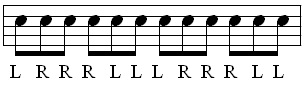
Week four. Using the shoulder rather than the elbow for traditional grip accents, writing a paragraph a day with the wrong hand, why you should practise doubles and triples inverted, and two exercises in groups of five.
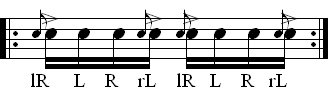
Week three. Why traditional grip players angle the snare, moving your mouse to the other hand, how to actually match a pair of sticks by sound rather than trusting the label, swapping hands on the hi-hat, and the pataflafla led with the weak hand.
Kevin Tuck sends in a video for critique. What he is already doing well — particularly his rebound — then a detailed look at wrist bend, left hand position, forearm rotation, fulcrum slip, thumb contact, and his paradiddles and Swiss army triplets.
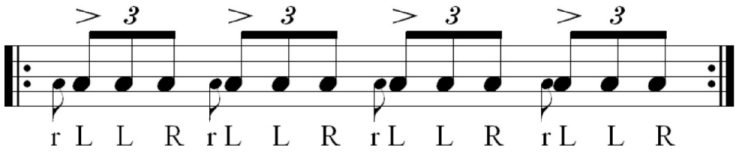
Week two. Hand turning for traditional grip, brushing your teeth with the wrong hand, playing both hands in unison to expose the differences, a weak-hand pattern to work on, and the Swiss army triplet. Plus a note on practise versus practice.
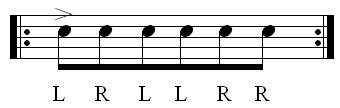
The first of a weekly series. Five tips for getting the weak hand to catch up — finding the balance point for traditional grip, a screwdriver exercise away from the kit, mirror work, leading with the weak hand, and the paradiddlediddle. With two exercises to play.
Where you hold the stick matters more than how. Using a see-saw to explain centre of gravity, why the centre of gravity is not actually where you want the fulcrum, and what changes the instant a moving stick meets the drum.
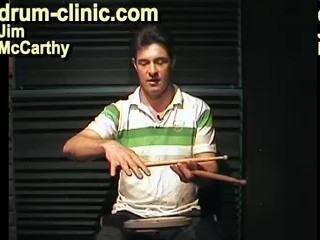
The follow-up to the grip question. Where exactly the fulcrum belongs, why just behind the middle knuckle of the index finger, and what you give up by letting it drift to the lower fingers — including the jazz habit of releasing the stick at the point of contact.
A drummer sends in a video of himself playing from the elbow, wrist and fingers, and asks what I think. Here is the reply in full — where the fulcrum is going wrong, why the finger stroke is killing the rebound, and the basketball test that fixes it.
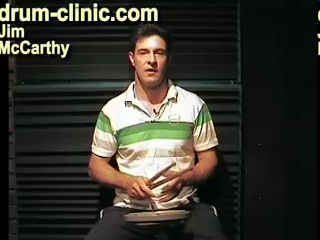
One of the questions I get asked most often — and a debate that predates the drum kit entirely. A look at where each grip comes from, what the French grip does better, where it costs you, and why I use something closer to the German grip for general playing.