Drumming · Technique · Rudiments · Gear · Lessons & Learning
5 Drumming Technique Tips
5 tips for building up the weaker hand — week 07
Tip 1 — Tip for traditional grip users
DON’T BE FOOLED! Don’t waste time working on using the index finger for finger control with the traditional grip, because it is not physically possible to power the stick this way!
Now before you argue that many great and professional drummers say you can and should — just have a closer look, and a hard think about it. These players don’t actually use the index finger at all, although they can make it LOOK that way. The index finger cannot bend sideways at the middle or end knuckle without being broken — it just doesn’t hinge in that direction. Sure you can turn your hand palm down and use the finger that way on top of the stick, but if you do that, you might as well use matched grip!
The tip of the finger often sits on top of the stick with traditional grip and its job is to control — or more accurately prevent in a controlled way — the rebound. If you want to power the stick without rotating the forearm, then you need to use the thumb. Pressing the thumb over the top of the stick just inside the fulcrum is the only way to employ “active” finger control with the traditional left hand grip — no matter who says otherwise, it’s just common sense!
Tip 2 — Tip not involving drumming
This week’s tip in this category is a good one because it still involves music and who knows — it may even lead to a total prevention of all those misguided drummer jokes!
Find a piano or electric keyboard of some kind and learn to play a simple scale. The purpose of the exercise is not to become an expert in harmony or music theory (although it never hurts!) so it can be any scale — just C major will do. Try to get somebody who actually plays to show you, or find out by researching the internet — just make sure you are using all the fingers rather than simply poking with one finger, as that would defeat the purpose of the exercise.
The idea is that by playing a scale a few times a day with your weaker hand, you will greatly improve the strength and dexterity of your fingers. If you ever want to take up percussion in the broader sense and play some tuned instruments like vibraphone, xylophone or marimba, then knowing a scale or two is a great start as well.
Tip 3 — Tip for evenness and matching the hands
Hopefully as a drummer who is keen to improve, you have more than just one pair of sticks! Hopefully you will have a range of different sticks to cater for various types of music and playing situations. With a bit of luck you will also own a pair of brushes and perhaps some of the many varieties of things which are half drumstick and half brush like “flix” or “hot rods” etc.
Some cool effects that are often overlooked by drummers can be achieved by mixing these up and using different tools in each hand. This creates an uneven sound which may give a song that unique feel, but can also be used to force a bigger work rate from one hand.
Try using a responsive stick in your strong hand, and something very unresponsive in your weak hand — say a hot-rod or even a brush. Play through some things that you would ordinarily play with a matched pair of sticks. It doesn’t really matter if it is a chart on the kit, or rudiments etc on the practise pad — the idea is to aim for the same sound you would normally get with matched sticks. This should really help any habitual laziness with the weak hand!
Tip 4 — Playing more notes with the weak hand, or leading with the weak hand
This week’s tip is about leading with the weak hand, and it is really focused on drum kit players.
Have you ever wondered why most types of traditional popular music have 95% of all drum fills basically descending in pitch? You rarely hear a drummer work their way from the floor tom up! For that matter why do we set the kit up that way with the high drums on the left? (for a right hander) Pianos and just about all other instruments with a linear layout have the low notes on the left, but we have the low notes on the right — and for that matter most Latin percussion instruments like congas tend to have the high drums on the left as well. Interestingly enough most classically trained percussionists are quite used to having their setups the other way around — like a piano, or one of the tuned percussion instruments that they will probably have to be able to play, like xylophone, marimba, glockenspiel or vibraphone.
It seems that the answer lies in making the strong hand dominant. In popular music where melody etc is not a concern for your average drummer, we tend to have the high drums on the left so as we play descending lines, the right hand can lead with less crossing over of the hands. As to why we mostly play only descending fills — well come to think of it there’s just no really good reason. To me it seems mostly a matter of habit and tradition, and perhaps ease given that we have set the kit up that way.
Tip 5 — General weak-hand skill exercise
This week’s exercise is a relatively simple one — as usual written for the right hander, so lefties swap the sticking over. Even though it’s simple it will really get your weak hand working hard. Not only that, but the weak hand is playing all four of the “work” strokes — the ones utilizing the extreme ends of the dynamic range where the natural rebound is very little help.
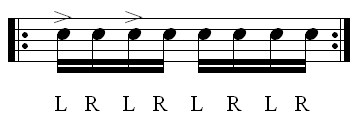
This is all about developing control in the weak hand, particularly with changing dynamic levels. The strong hand is just ticking over playing soft notes. The weak hand however should be playing a full stroke, then a down stroke, then a tap stroke, then an up stroke.
If you are not sure what these are, then I strongly urge you to find out asap because you really should know. Ask your teacher to explain it to you, or alternatively check out my book “Stick Technique” available at www.sticktechnique.com
As usual — the blatant self promotion: check out the “Stick Technique” book at www.sticktechnique.com for heaps more info on drumming technique.