Drumming · Technique · Rudiments · Gear · Lessons & Learning
5 Drumming Technique Tips
5 tips for building up the weaker hand — week 09
Tip 1 — Tip for traditional grip users
Here’s a tip that orchestral percussionists might appreciate — or marching enthusiasts.
Your average big bass drum is mostly played with a beater in either hand, and one hand on either side of the drum. In most scenarios this is actually the best way to play it and will get the most control over the sound and the smoother sounding rolls etc. The exception of course is particularly when the heads on either side of the drum are different or differently tuned. In this case it might actually be easier to play with both hands working on the same head of the drum.
Traditional grip drummers will have an advantage here. Matched grip players will find the required playing position quite difficult with a vertical bass drum. You could of course mount the drum more horizontally, but this usually involves a significant compromise in the sound produced — much less sustain. Traditional grippers can use the left hand quite easily on the same side of a vertical drum as the right hand — after all this is really very similar to an angled snare drum anyway, which is the actual reason for the existence of the traditional grip!
Trying to play strong notes with a big bass drum beater using traditional grip is hard work though, and fantastic for building up strength in the fulcrum. Here’s what to try: find your latest snare solo or exercises, and try playing them on a vertically mounted bass drum at least once a day this week. Watch your fulcrum build!
Tip 2 — Tip not involving drumming
Here’s something you can do with your weaker hand if you just happen to be doing some home decorating. Painting!
Sound strange? Well some of you might remember the old “Karate Kid” movie and the instruction to “paint the fence”. Half the panels had to be done with one hand and the other half with the other hand. It doesn’t have to be a fence of course, it can be pretty much anything — but you may have noticed in the past that it’s quite easy to perform good long strokes with a paintbrush in the strong hand, while we tend to dab and swish with the weaker hand.
Next time you are painting, use the weak hand and really concentrate on making good long vertical strokes. Make sure the wrist is bending up and down smoothly with each stroke.
Tip 3 — Tip for evenness and matching the hands
This week’s tip is quite similar to last week’s. Rather than using differing pitch to get the weak hand overcompensating though, we are going to use different feeling surfaces.
The ultimate here is to use a snare or practise pad under the strong hand, and a pillow under the weak hand. This will really make the weak hand work extra hard, but a pillow is probably too soft to make a sound that is very useful in terms of trying to produce an even sound or feel.
If you are working on drum kit, a great thing to do is swap the positions of your snare drum and floor tom (I’m assuming your setup is standard here). So now you can play with your strong hand on the snare, and your weak hand on the floor tom. Now go through a bunch of rudiments. Build the speed as you might normally do during a practise session until you are working at close to your top rate. This is where the softer surface of the floor tom will really make the weak hand work harder to stay in the same league as the strong one.
Tip 4 — Playing more notes with the weak hand, or leading with the weak hand
This tip is a really good one for drum kit players. Not only is it great because it makes the weak hand play twice as many notes as the strong one — but also it is a good “cheat’s” way to play typical double kick rhythms when you don’t have two bass drums, or a double pedal. As usual it is shown here for a right hander so swap it around if you’re a leftie.
You can see that the first note of each beat leads with a bass drum note followed by the strong hand playing a floor tom note. This is the “simulated” bass drum that is useful if your foot is not so fast, or getting tired. The weak hand then plays a double stroke on any drum you like — higher pitch. I’ve shown it here going from the snare to the two rack toms, but you can make any pattern you like of course.
You might even like to actually lead with the weak hand by swapping the halves of each beat. This means the weak hand starts with the double stroke, then you have the kick note, then the floor tom note for each beat.
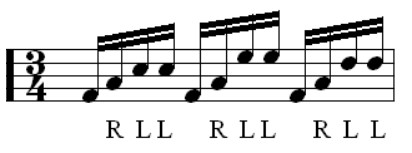
Tip 5 — General weak-hand skill exercise
Here’s another great skill exercise that is useful for drum kit players because it actually creates a nice groove — a bit like a double time feel. Not only does the weak hand play an extra note, but it has to be quicker as well. The little double stroke in each beat will take some conscious work from the weak hand to get it sounding strong and clean.
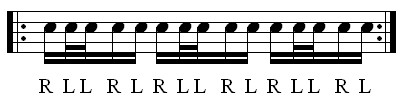
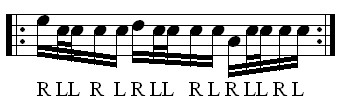
The version above is a simple version played on the practise pad or snare. You can easily adapt it to create nice kit beats by adding foot patterns underneath, or moving some of the notes to other drums. Below is a simple example I’ve created just by moving the first note of each beat to a different drum. These notes can be accented if you like, to further emphasize the beat.
As usual — the blatant self promotion: check out the “Stick Technique” book at www.sticktechnique.com for heaps more info on drumming technique.