Drumming · Technique · Rudiments · Gear · Lessons & Learning
Drum stick twirling and stick spinning tutorial
The video here is all about twirling drum sticks or spinning drum sticks, and how to basically incorporate it into your playing. There is also a sneak preview of the more advanced technique called the “twirl over”. You can find tremendous detail about that and other drumstick “tricks” or “effects” in the Stick Technique book at www.sticktechnique.com
There are quite a few different ways to twirl or spin a drum stick and they can all look fantastic in the hands of an expert. Essentially though, they all fall into two different categories…
One — what some people call the “REAL TWIRL”, but is more properly referred to simply as the spin.
Two — what some people call the “FAKE TWIRL”, but is more properly referred to as the twirl.
Spins
The “real twirls”, or spins, are methods of feeding the drum stick through the various fingers, turning it as you go. There are various combinations of fingers and cool direction changes that one can do.
The problem with all of these kinds of technique is that they are little more than a one-off parlour trick. What I mean by this is that they are virtually impossible to incorporate into your playing in any meaningful way. Sure, you can play some notes with one hand whilst the other spins the stick around, and you can even make it look pretty cool — anyone who has seen Virgil Donati play will testify to the visual effects possible. Even Virgil though cannot really go from playing to spinning and back without a pretty significant delay. There needs to be a reasonable period of time where the spinning hand is not required to play any notes.
Twirls
The “fake twirls” — more properly simply called twirls — are a very different beast! This kind of twirling uses a bit of visual trickery. The stick doesn’t actually turn end over end at all, but the tip of the stick does move in a circular arc, giving the impression of an end-over-end motion. Usually the stick is held between the index finger and finger two.
To understand how it works, it’s really best to have a look at the video above, but I’ve included a couple of low-res versions below of pictures from the Stick Technique book, just so you can get an idea.
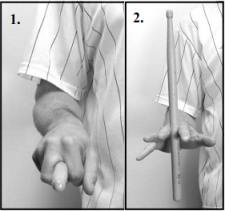
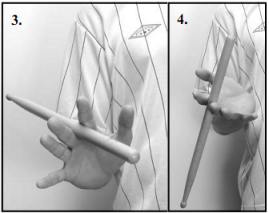
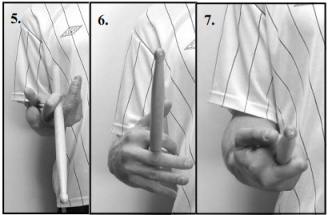
You can see from these pictures how the grip remains the same throughout the action. This makes the twirl much more “robust” than spinning — you are less likely to drop the stick.
Not only that, but the grip is actually very close to a normal “matched” grip position. You can see from picture one that all you have to do is put the index finger over the stick to change from one to the other. In fact you don’t even have to change back to a proper grip to play. It is quite easy to play quite well with the stick held in this “twirling grip” — the only real difference is that the fulcrum is between two different fingers, and that there are only three fingers for finger control rather than four.
Because of this, it is very easy to twirl the stick in between notes played on the drum. There is virtually zero transition time between playing the note and the twirling action, AND the firmer grip on the stick enables much more powerful acceleration of the stick into the twirl. In contrast, spinning the stick through the fingers has none of these benefits.
Jim McCarthy
This information is based on ideas taken from the book “Stick Technique”. Find out more at www.sticktechnique.com.