Drumming · Technique · Rudiments · Gear · Lessons & Learning
5 Drumming Technique Tips
5 tips for building up the weaker hand — week 04
Tip 1 — Tip for traditional grip users
Many users of the traditional grip have real trouble with producing seriously strong accents with the left hand. Sure this may partially just be due to the natural right handedness of most drummers. Also though, many trad players don’t really use their elbow in a useful way.
It is actually possible to use a bending of the elbow (just like doing a bicep curl) to get stick height. Many drummers do this, but it is only useful in a partial way as this motion does not combine well with the natural forearm rotation which is the primary traditional grip movement. BECAUSE it does not combine well you might actually use it for this specific reason — for example if you want to isolate the movements to get a clearer distinction between accented and unaccented notes.
If you really want to ADD to the normal rotation action for a stronger note however, you need to use the elbow in a different way. Rather than bending the arm at the elbow joint, you can bend at the shoulder — swinging the elbow joint itself from a high position to the side of the body to a low position, pushing it past vertical and actually in front of the body. This will result in a much greater overall degree of rotation and the action is a bit like a chicken flapping its wing!
Tip 2 — Tip not involving drumming
Here’s a really great exercise to work the fine control and co-ordination of your weaker hand. Remember that old fashioned writing tool, the pen? Now personally my handwriting is really terrible with either hand, but one thing’s for sure — it’s worse, and a great deal slower, with my left hand. Let’s face it — handwriting is something we always do with our dominant hand.
So this week grab a pen and a notepad, and get writing with your weaker hand. The idea is to write out one paragraph a day this way. No cheating with short ones like “The cat sat on the mat”, the end. Here’s an idea — you have five tips here this week, so use them: write out one of them a day with your weak hand.
Tip 3 — Tip for evenness and matching the hands
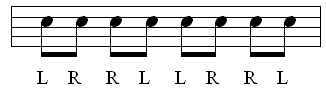
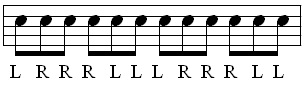
One of the issues commonly associated with evenness, is the loss of power when using rebound to produce double strokes or triple strokes. Now this is not strictly an issue to do with the left hand vs the right, but certainly a problem to do with evenness, and one usually much worse on the weaker hand. You will notice the exercises below actually “lead” (start with) the left hand. (Lead with the right if you are left handed.)
There are a whole bunch of reasons why this loss of rebound power occurs and a whole bunch of methods to overcome them — far too much to cover in depth here. These are technical aspects of drumming, and even though it’s blatant self promotion… your best bet if you want to understand this topic thoroughly is to read through that section in the book “Stick Technique”.
Here we are going to look at the “mental” issue associated with doubles and triples. Simply put, we just get used to hearing them unevenly so we don’t hear the problem. When we play doubles or triples, we invariably have the first note of the group falling on the beat. This is also where we naturally feel an emphasis so playing them this way makes a lot of sense given that physically this is also where the emphasis tends to fall naturally.
Now in performance this is all very well because the physical tendencies work in nicely with the musical requirements. In practise however, we are effectively practicing an uneven sound. The best cure is to practise your doubles and triples inverted — as shown below. This is where the last note of each hand’s group is the one which falls on the beat. This is tricky, but the great thing is that your perception of where the beat is (natural emphasis) falls on the last note of the group — ie the one that from a physical point of view is naturally the weakest.
Tip 4 — Playing more notes with the weak hand, or leading with the weak hand
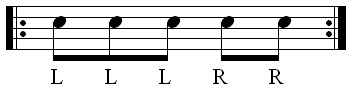
Here is a really simple exercise for working the weak hand — in fact it’s almost as simple as it gets! Not only does the weak hand play more notes, but it leads as well. This one is good for both evening out the hands and building your fulcrum and finger abilities in the weak hand. Some drummers may find that they have to work with this for a while before they can even get it fast enough to become a physical challenge. We are not so used to groups of five or even alternating so often between two and three, so you may have to overcome that mental challenge first. Lefties will as usual have to reverse the sticking pattern shown.
Tip 5 — General weak-hand skill exercise
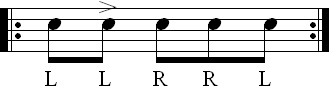
This week’s exercise in this category, is just a slightly altered version of the exercise above in the fourth tip. We still have five notes, three of which are performed with the weaker hand. This time though, we will borrow from tip three above, and use some inversion on the triple stroke. The middle note of the triple stroke is on the down beat, and the third note is accented, so there is sort of two types of inversion going on here.
The real physical challenge of this exercise comes about because of the accent and its position. Being on the middle note of the group, it means that it is difficult to use arm lift to get the stick height because there is very little time. Not only that, but you cannot really use a “snap” technique to get the accent either because there is a following note. This really works the wrist on the weaker hand — shown below as usual as the left. If you are not sure what I mean by a “snap”… well there is more than one type but there’s too much to say here, so you should read all about it in the “Stick Technique” book — follow the link below.
As usual — the blatant self promotion: check out the “Stick Technique” book at www.sticktechnique.com for heaps of info on drumming technique.