Drumming · Technique · Rudiments · Gear · Lessons & Learning
5 Drumming Technique Tips
5 tips for building up the weaker hand — week 02
Tip 1 — Tip for traditional grip users
Most users of the traditional grip will likely be familiar with the exercise called “Hand Turning”. The idea is that we are putting extra stress on the fulcrum whilst exercising it, by removing any possible “cheating” support from the other fingers. Usually hand turning is done with the balance point in the fulcrum as normal, but with all the fingers straight out and the palm flat.
The idea is that we simply turn the hand through 90 degrees or more from the palm down position to the “handshake” position or even slightly further. Try to do this in the same manner as a normal stroke, using rebound as much as possible and keep the movement continuous. Five continuous minutes of this type of maximum extension playing will quite likely be quite tiring for most of us, and we might find the stick sliding through the fulcrum. In fact if we hold the stick further towards the butt there is even more difficulty involved and more stress on the fulcrum, so it’s not a bad idea to do a minute or two like this even if it is nothing like the way we would normally play.
Tip 2 — Tip not involving drumming
In the morning and at night — or whenever you brush your teeth… Do it with your weaker hand. Admit it — you always brush your teeth with your strong hand… right? This week, do it with the other. Be careful and go slow though because if you are uncoordinated with the weak hand like me, you might end up with bruised gums!
Tip 3 — Tip for evenness and matching the hands
Here’s a great tip idea to get both those hands working in the same way. Play rhythms with both hands together doing the same thing. Start with something really simple like just steady continuous quavers. Start slow and listen carefully. Make sure both hands are hitting at exactly the same time and try to get them working the same way if using matched grip.
Gradually speed up and work to keep the hands synchronized. As you speed up you will probably find either your weak hand can’t keep up the pace and falls behind, or it starts playing softer than the strong hand. This also usually results in a lack of togetherness anyway. Try the same concept with other simple rhythms like “quaver, quaver, crotchet” (eighth, eighth, quarter — for those of us who use that system) Also try these variations working in different ways — eg. just from the wrist or just from the fingers.
Tip 4 — Playing more notes with the weak hand, or leading with the weak hand
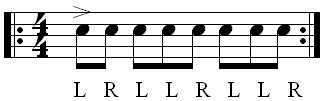
Here is a nice pattern for strengthening the weak hand. It involves a LH accent, a change in LH volume, LH double strokes with little rest between — and overall just more LH notes than RH notes. As usual, start slowly, preferably with a metronome, and build up the speed gradually. (Remember to swap LH for RH if you are a left hander!)
Tip 5 — General weak-hand skill exercise
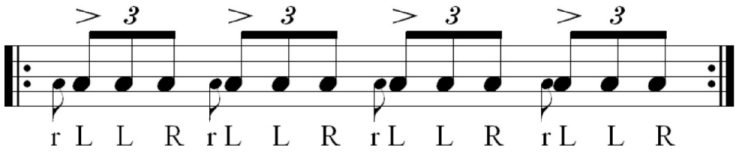
Just like last week, tip five is a rudiment. And just like last week it is one of my favorites as long as it is on the right hand, but I’m way less keen on it for the left! That means it’s time to practise it heaps on the left this week (or right if you’re a lefty) Ladies and gentlemen… I give you the “Swiss army triplet”!
Work that left arm and make sure you have ONLY the first note accented. Too often this one starts to acquire an accent on the second note as well as it speeds up. Use the arm for the height of the accent and allow the rebounded second note to just rebound into the wrist or fingers.
Little footnote thought for the day…
Why is it that my spell checker will not accept the word “practise”???
Just to clear it up (hope you are listening spell checker!)
Practise as a verb is spelt with an “S” — as in “I’m practising my rudiments”.
Practice as a noun is spelt with a “C” — as in “the doctor owned a medical practice.”
As usual — the blatant self promotion: check out the “Stick Technique” book at www.sticktechnique.com for heaps of info on drumming technique.