Drumming · Technique · Rudiments · Gear · Lessons & Learning
The paradiddle in depth, and related rudiments
Here is some pretty complete info about the single paradiddle, from beginner level to very advanced. The principles outlined here can in fact be applied to just about any rudiment — in fact drumming in general — but I’ve chosen the paradiddle as it is probably the best known rudiment past singles and doubles. Even non-drummers have often heard of a paradiddle!
Now I’m not going to spend hours writing down the whole content of the video blog here, as it would take too long and be quite a long read as well. Really the best thing for you to do is to just watch the two videos a couple of times.
Part one
Part two
As a bonus, I’ve taken a few excerpts from the book “Stick Technique” which are relevant to the single paradiddle and presented them here for you. If you really want to go into maximum depth with your paradiddle rudiments — and others — the best thing is to check out the whole book, which you can do at www.sticktechnique.com.
Here it is:
Some basic but essential rudiments (movement by movement)
The idea of this two-page section is to explain the kind of thinking we should do every time we learn a rudiment — or any combination of notes that we are having difficulty with, or would like to improve.
To perfect a combination of notes, we need to look very simply at each note separately to decide what stroke type it is in its most exaggerated form. It will be either a full stroke, tap, down stroke or up stroke. The calculation is based simply on whether the note is loud or soft, and on whether the next note that same hand has to play is loud or soft.
When we can execute each note slowly by itself in the correct order, then we are playing the rudiment in the most efficient possible way — and as we begin to work on speeding it up there should be no wasted movement taking up extra time!
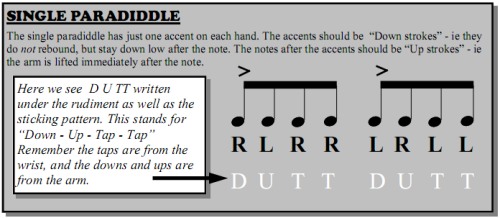
Advanced rudiment technique (some simple rudiments at much higher speeds)
This section looks at what happens when we start using some of our basic motions much faster. As we combine the fundamental movements to create patterns of notes — or “rudiments” if you like — the perfect versions of the movements actually need to be compromised to varying degrees. Each note affects the one next to it a little bit.
The basic principle here is that, at much faster tempos, it is not so much that there is no time for excess stick movements (although there certainly isn’t!) but that there is no time for excess muscle movements.
The answer to this problem lies in both the type and timing of the muscular actions we DO use. Essentially we aim to get more than one note from each action. Going through the following example rudiments will give you a start at thinking along these lines — remember though, that this is really only applicable as we reach our maximum physical potential.
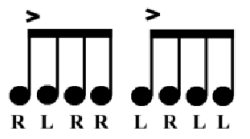
Single paradiddle
In the end analysis, performance of this rudiment comes down to relaxing the grip and joints and, as much as possible, letting the sticks do what they want to do anyway. All of the active muscle movement will end up being arm movement, with the wrists and fingers just controlling the rebound in a passive fashion.
Try this experiment:
Hold the stick loosely at its balance point between two fingers, and have no other part of your hand touching the stick. Let the stick fall to the drum head from about 20cm and allow it to bounce twice — hitting three times all together. Listen carefully to the rhythm produced in these three notes. It should be fairly close to this:
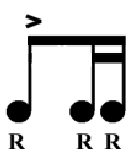
The first note will be the loudest, and bounce the highest. All successive bounces will be softer and lower — getting faster as they lose height.
Compare this to one hand of the paradiddle.
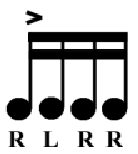
The rhythm is so close that at high speeds, if we just think of placing the accents, the other notes should automatically occur — providing we are relaxed, and have practised the rudiment sufficiently at slow speeds.
This may sound obvious and easy, but the reality is that most of us will find it quite difficult to perform the double stroke 100% from natural rebound. This is partially because we get used to thinking of the first note as a “down stroke” where we actually try to kill the rebound.
The other main obstacle is one of coordination. We need to be able to coordinate the passive controlling of the rebound from the original accent — which obtains the double stroke — with the simultaneous large upwards movement of the other arm performing the second note of the rudiment.
This information is based on ideas taken from the book “Stick Technique”. Find out more at www.sticktechnique.com.