Drumming · Technique · Rudiments · Gear · Lessons & Learning
5 Drumming Technique Tips
5 tips for building up the weaker hand — week 10
Tip 1 — Tip for traditional grip users
Users of traditional grip face a fairly basic and fundamental coordination challenge every single time they pick up a pair of drumsticks. It is this: your two hands are essentially using completely different motions. The right hand is using an up/down bend of the wrist along with an up/down bend of the elbow. The left hand is using a twisting of the forearm along with an in/out swing of the elbow.
After some thinking I’ve come up with a cool exercise for you to help coordinate these two different motions together. It’s kind of like a pat the head and rub the belly exercise, but this one is actually useful from a musical point of view and something all drummers and percussionists might be required to do at some point anyway.
You will need to find a tambourine — any sort will do for this exercise — and a shaker. You can always make a shaker out of some rice or little stones in an old tin can if you don’t have one.
The left hand will hold the tambourine and perform a sustained roll. The idea is to hold it in front of you with a bent elbow, so it is similar to a traditional snare drum grip playing position. You use a twisting motion of the arm to perform the roll. The right hand will hold the shaker up in front of your face with the fingers out and the thumb behind. The motion of the shaker is kind of like an upside down right hand snare drum grip — partly from the elbow and partly a back/forth bending of the wrist.
So the exercise then is to perform a sustained roll of the tambourine with the left hand whilst simultaneously performing a steady rhythmic shaking with the right hand. This is a pretty useful thing to do as a percussionist anyway, but it is also an alternative way to practise the essential muscle movements required to play with an unmatched grip.
Tip 2 — Tip not involving drumming
This week’s tip is a cool one for drum kit players. Snare drummers — don’t worry — you can do it as well with just a few cents investment buying a bolt and wingnut from the local hardware store. Drum kit players and most percussionists already have bolts and wingnuts built into the end of their cymbal stands! ;-)
Drummers, have you ever noticed how every single time you set up and break down your kit, the urge to use your strong hand to twiddle the wingnut is almost overpowering? Let’s start doing it the other way around. Use your weaker hand to twirl the wingnuts — and no cheating by using the ole’ “hit n’ spin” method we all love to speed up the process. No, I want you to actually turn the wingnut by gripping and twisting the whole way. A little thing, but over time this will improve the abilities of your fingers and wrist on the weaker hand.
Tip 3 — Tip for evenness and matching the hands
This week’s tip for improving evenness is simply a technical explanation that in my experience few drummers actually ever consider — even though it is one of the most important. It is for playing even double and triple strokes.
Most drummers become aware at some point that you need to use some form of active finger control if you want to play doubles or triples fast and strongly. Some even realize the fact that you need to incorporate a movement from the elbow for each bounced group if you want to maximize speed and power. What many drummers never understand is why their doubles and triples always seem to fade when they play very quickly or very strongly. Here’s some explanation.
At top speed, multiple strokes rely purely on rebound, and finger power around the fulcrum between thumb and finger. The volume of the initial stroke is not really limited, because it can have all the motion of the forearm behind it. The forearm is only moving once for each multiple stroke, so in effect it only needs one quarter of the speed that the rebounded finger notes need. This means there is plenty of time to get some stroke height. So — as I said — the initial stroke can be as loud as you like.
Unfortunately the same thing is not true of the successive notes. The volume of the rebounded finger notes is quite limited. It is limited to the stroke height that can happen purely with rotation of the stick through the fulcrum — and in practise not even 100% of that, as faster speeds will not allow enough time for full rotation.
The problem most drummers have when they start using a combination of forearm movement and active finger control, is that they add the finger power to ALL of the notes. This always creates an uneven sound. The initial note has arm power AND finger power, but the second and/or third notes have only finger power. Of course the initial note is always much louder and the double or triple strokes sound pulsed and uneven.
The real challenge is to let the initial note of each group be powered ONLY from the arm. The rebounded energy should rotate the stick through the fulcrum a little, then the fingers should power the stick back around a little past the initial contact angle to create the second note. The initial note is powered from the arm and the other notes from the fingers. As long as the power of the initial arm motion does not exceed the potential power of the fingers, it is possible to create even doubles or triples.
Tip 4 — Playing more notes with the weak hand, or leading with the weak hand
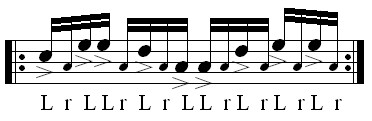
Here is a cool little groove to play with the hands on a drum kit. You can expand it by adding a pattern for the feet to play simultaneously. You can also change the essential pattern if you like, or continuously vary it — in this case it’s the basic idea which is important.
To explain: a fairly common way of playing fills and grooves on kit is to lead strongly with the right hand — the right hand playing accented notes around the kit to a certain rhythm. The left hand then fills in all the gaps with very light (or ghosted) snare drum notes. This exercise is a reversal of that process. The left hand is the one playing the accented rhythms and moving from drum to drum, while the right is filling in all the gaps with much softer floor tom notes.
The example written below is written as usual for a standard right hander on a standard right-hand drum kit. Lefties will have to swap things as appropriate.
Tip 5 — General weak-hand skill exercise
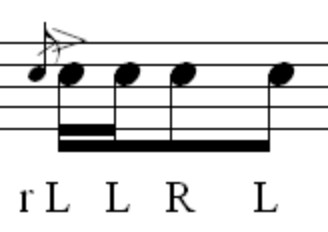
This week’s general skill exercise is a really tough one to do quickly! As usual it is written for a right hander, so lefties swap the sticking pattern.
The obvious difficulties are that the weak hand is playing an extra note, and that its notes are faster — less gap between them. More difficulty is brought by the requirement of the weak hand to change speed in the middle of its triple stroke, and also of course the requirement to go from soft to loud to soft.
The points to watch are — one: getting a quality up stroke on the last note, making sure you begin lifting the arm as early as possible and lead the lift with the wrist joint rather than the tip of the stick. Two: the accented double stroke is performed with height from the elbow. The second part of the double stroke is purely rebounded from the accent and controlled from the fingers only.
As usual — the blatant self promotion: check out the “Stick Technique” book at www.sticktechnique.com for heaps more info on drumming technique.